Darshan Desai Uncrowned Tue, October 20, 2026 at 3:43 AM UTC · 6 min read About Our Ads Advertisement Advertisement Advertisement "In boxing, you can never have control. It's out of control. But you've got to be up for being in that world."
That was Eddie Hearn's warning when TKO — the parent company of UFC and WWE — entered the sport with Zuffa Boxing earlier this year.
A little over three months with Shakur Stevenson has given Dana White a taste of exactly what his promotional rival meant.
On Monday, Stevenson announced he had secured his release from White's promotion , ending a partnership that produced multiple rounds of failed negotiations and not a single fight.
Stevenson, the WBO super lightweight world champion and Uncrowned's No. 4 pound-for-pound fighter , was Zuffa's most high-profile signing since its inception in January. His departure exposes a fundamental problem with importing the UFC model into boxing: Signing a star does not give you control over the fights that make him valuable.
With UFC, TKO operates from a position of overwhelming strength. It controls most of the opponents its fighters want to face, and the platform on which these fights can happen. A fighter can push for a different opponent or a better offer, but the UFC ultimately controls whether those alternatives materialize. The choice is largely to accept the company's terms or wait, as UFC middleweight champion Sean Strickland recently discovered .
With Stevenson, the balance of power was different. Although Zuffa had secured his signature, all of his most desirable opponents were outside its stable. Their purses, schedules, and willingness to fight him — and vice versa — were beyond White's control.
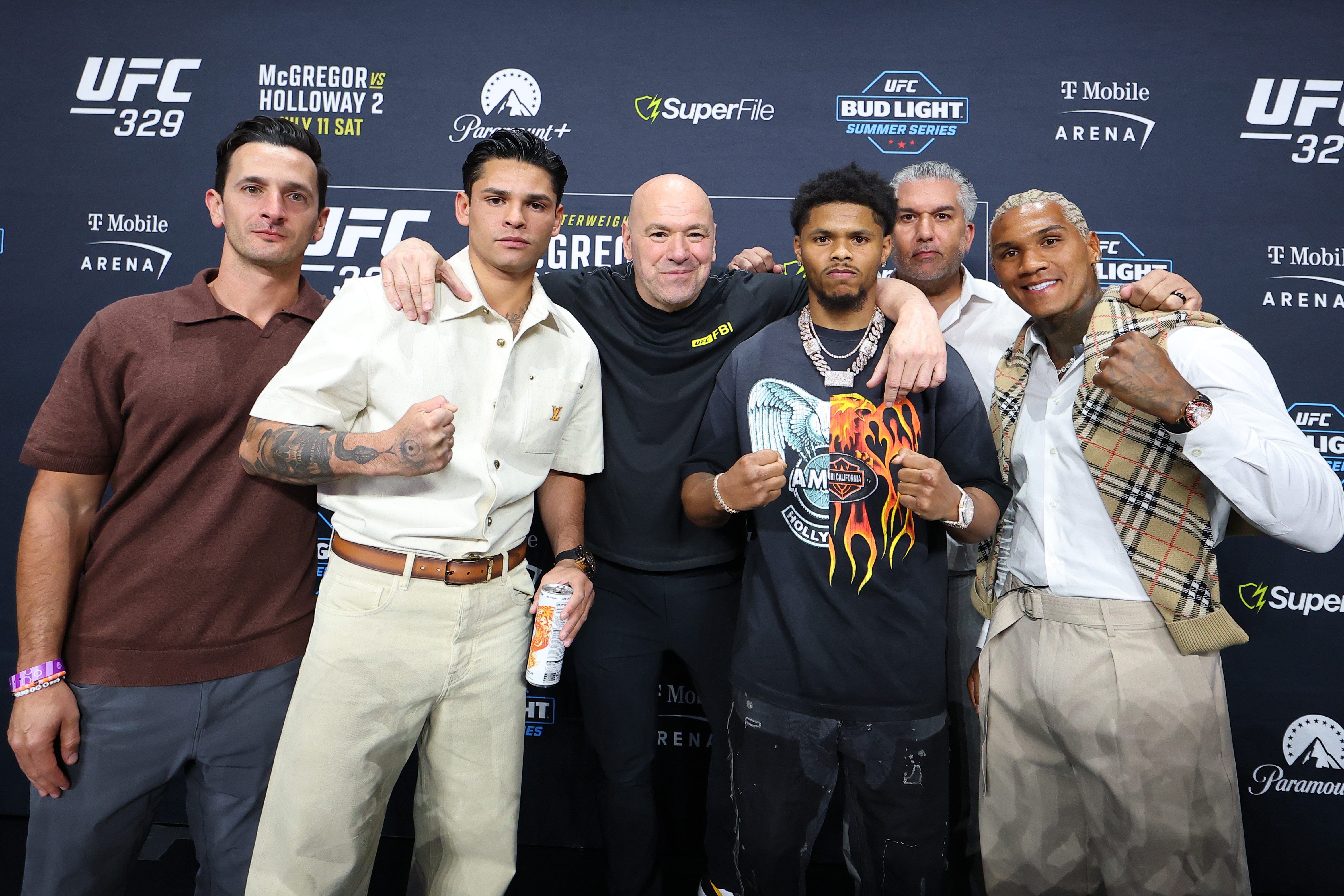
Shakur Stevenson's (third from right) time with Dana White's Zuffa Boxing ended Monday without a single fight.
The obvious starting point for the four-division champion was Jose "Rayo" Valenzuela, the most high-profile lightweight in Zuffa's stable. Stevenson instantly dismissed that matchup. White, who had said he wouldn't work with other promoters, was forced to look beyond his own roster almost immediately.
There, he encountered the same obstacles that have frustrated boxing's established promoters for decades.
A unification fight with WBA super lightweight champion Gary Antuanne Russell was explored, but Russell wanted $3 million — a number Zuffa was not willing to pay. A mandatory defense against Raymond Muratalla proved similarly unfeasible. There were attempts to place Stevenson on the Tyson Fury vs. Anthony Joshua undercard, potentially against Manny Pacquiao, but those discussions soon hit a financial roadblock.
With nothing else on the table, Zuffa then pivoted and let Stevenson try to make a fight with WBO welterweight champion Devin Haney.
A matchup between Stevenson and Haney — two of boxing's leading stars under 30 — had been explored earlier this year while Haney was considering signing with Zuffa. When Haney joined DAZN , though, it was thought to be out of the picture because the boxers were aligned with different networks.
However, with Zuffa and Paramount unable to make a meaningful fight for Stevenson themselves, they were prepared to let him fight on DAZN. Zuffa waved the white flag, so to speak — White and company had to agree to let their biggest star make his promotional debut … on a rival broadcaster.
Disagreements over money and weight proved decisive, and in the end, Zuffa was left with no Stevenson-Haney fight, no opponent to match Stevenson with on its own show, and no clear next step.
Stevenson wanted around $15 million to face Haney, sources close to the situation told Uncrowned. According to boxing reporter Sean Zittel, he sought the same number to take on Valenzuela under the Zuffa banner, while the promotion offered $7 million. Stevenson's team told Uncrowned's Ariel Helwani on Monday that he had been "frustrated as of late" with the direction of his career under Zuffa.
Conor Benn infamously made $15 million for his Zuffa debut against Regis Prograis. The industry consensus was that Zuffa deliberately overpaid to make the offer unmatchable for Hearn's Matchroom before moving forward with a deal closer to market value. But that strategy also created a benchmark. And Stevenson felt he could demand that sum too.
Stevenson exercised the bargaining power that comes with being a star in boxing. He rejected an opponent, refused to fight at welterweight, and demanded top dollar for matchups.
That is the difficulty facing Zuffa. The names it wants to attract are already stars in their own rights. They have options. Zuffa has to navigate fighters' choices and freedom — and worse, most of the opponents they need to fight to make these deals work exist largely outside its control.
Zuffa has been linked to Ryan Garcia, who has two fights remaining on his DAZN contract. But with Teofimo Lopez, Haney and Stevenson outside its roster, signing Garcia would present a familiar problem: Securing the star while leaving his biggest fights dependent on deals with rival promoters and broadcasters.
What can Zuffa deliver for Garcia that it couldn't for Stevenson?
Stevenson, meanwhile, is now a free agent. And there is an obvious choice for his next move.
Garcia, Haney, Russell, Muratalla, Dalton Smith, Floyd Schofield and others — nearly all of the potential Stevenson opponents — have one thing in common: They fight on DAZN.
Stevenson's next move must put him in the DAZN sphere, whether that is through a promotional agreement with Matchroom, PBC, Top Rank, or Golden Boy, or a direct deal with DAZN, following in the footsteps of Haney and Lopez.
Shakur Stevenson hasn't fought since a January win over Teofimo Lopez.
Announcing his free agent status, the WBO super lightweight champion said:
"This time, I want to tell the fans and tell everyone in the public that I'm now taking my career in my own hands, and I'm starting my own promotional company, and I'm willing to work with other promoters and anybody else that's out there that's willing to be serious about my career as I am about my career."
With Stevenson looking to start his own promotional entity, a direct deal with DAZN may be the way to go. Stevenson can arrange his own fights with a budget from the streaming service and pay a promoter to be the service provider for the card, handle logistics, undercard bouts, and put together the event.
Stevenson was offered a deal directly by DAZN in the summer, which he described as "very similar" to his Zuffa offer. But here is the issue Stevenson will likely face: When DAZN made him that proposal, it was competing with a rival attempting to lock down all of the top talent in the sport.
Now that DAZN has Lopez, Haney, and Garcia on its platform, and Zuffa is no longer in the picture for Stevenson, the leverage is tilted more in DAZN's favor. Essentially, yesterday's price is not today's price, and Stevenson may not get the same money he was being offered earlier this year. Because if he doesn't sign with DAZN or a promoter on the network, where else can he even go?
A move to DAZN would put Stevenson on the same platform as many of the opponents he wants. It would not, however, resolve the disagreements over money and weight that helped derail the Haney fight.
Stevenson has taken back control of his career. Now, he needs to show a willingness to compromise to make the best fights.
Source: Sports
